

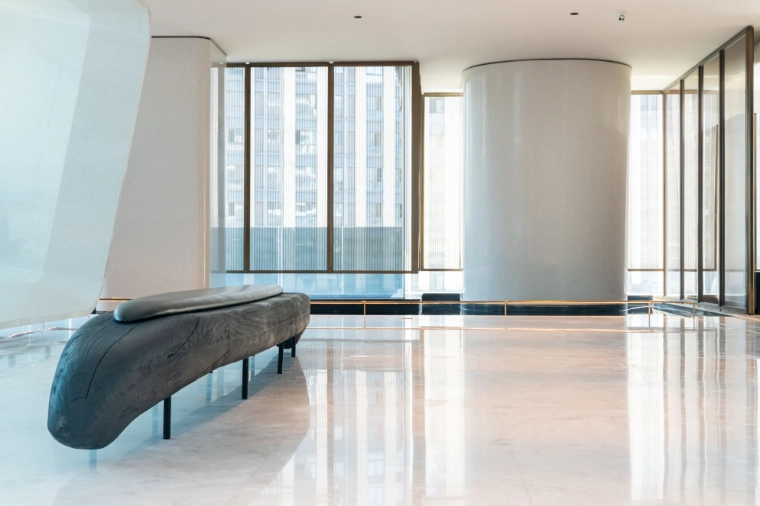
Imagine you have just entered your home after a hard day’s work. As you turn on the lights, you notice something curious: the granite island in your kitchen reflects light like a flawless black mirror, but the granite floor in your living room, although clean, seems to have a more subdued, almost timid shine. Isn’t it the same material? Why does the stone respond differently in each room?
This is one of the most common questions when hiring a floor polishing service in Panama. The answer lies not only in how much the surface is cleaned, but in a combination of geology, the physics of light, and the specific use of each square meter of your property. Understanding these differences is the first step in transforming a dull surface into a high-value aesthetic asset.
Practical tips for homeowners
If you want the granite in your living room to rival the splendor of your kitchen, consider the following points:
- Avoid using waxes: Waxes only create a yellowish layer that traps dirt. The real shine should come from the stone itself.
- Demand a pH test: The products used must be neutral. A highly acidic product will “burn” the shine, especially on granites with a high calcium content.
- Assess the methodology: Make sure your supplier uses high-performance vacuum systems to prevent silica dust from lodging in your air conditioning ducts.
The DNA behind the shine
Granite is mainly composed of quartz, feldspar, and mica. However, not all granites are the same. The hardness of these minerals is measured on the Mohs scale, where diamond ranks 10 and talc ranks 1. Granite usually ranges between 6 and 7.
The main factor that defines a professional result is that the hardness of the mineral determines the polishing technique. In the kitchen, it is common to find denser, darker granites, which have a more closed structure. In the living room, homeowners often opt for lighter-colored granites, which may contain veins of slightly softer or more porous minerals.
When a professional technician performs a floor polishing service in Panama, especially if it is granite, they do not apply the same pressure or the same polishing grain to one type of granite as they do to another. The friction required to close the pores of a grade 7 stone is dramatically higher than that of a grade 6 stone. If a generic technique is used, the light will not reflect evenly, creating that frustrating difference in brightness between rooms.
Why does location alter the stone’s brightness?
Even if the granite came from exactly the same batch, the environment dictates its optical behavior.
1. Mechanical wear vs. chemical attack
In the living room, the main enemy is mechanical friction. Foot traffic drags sand particles that act like microscopic sandpaper on the floor. This wear creates micro-scratches that scatter light rather than reflect it. In the kitchen, on the other hand, granite faces chemical attacks such as lemon acids, hot fats, and food residues.
2. Pore depth
A standard cleaning service can remove surface grease from the kitchen, making it shine. However, on the living room floor, dust lodges in the micro-porosity of the stone. If the polishing does not reach the technical depth required to remove this layer accumulated in the mineral, the floor will always look dull compared to low-traffic surfaces.
The role of professional floor polishing
Many people believe that shine comes from a liquid product, such as wax. The technical reality is that shine is the result of a physically smooth surface, which requires an abrasive process appropriate for the material and condition of the floor.
The process involves the use of discs ranging from coarse texture (to remove scratches) to extra-fine grit (to close the pores). For a property manager or office manager, understanding this is vital: you cannot “clean” the shine back into the stone; it must be mechanically polished.
Technical perspectives
There is a phenomenon called “orange peel” in granite. It occurs when the softer minerals in the stone (such as mica) are over-polished while the harder ones (quartz) remain intact. This creates a wavy surface at the microscopic level.
A high-end floor polishing service in Panama prevents this by using leveling plates and water cooling techniques. If the stone is overheated during the process, the minerals can undergo differential thermal expansion, causing micro-cracks that, in the long term, attract more dirt.
The safety and trust factor
For commercial property owners, operational risk is a constant concern, especially with a beautiful asset that will be treated with a floor polishing service in Panama. This is where the choice of provider makes all the difference. For example, Green Cleaning Services has liability insurance, which covers any damage to the client’s property that may occur directly during the performance of the contracted services. This offers peace of mind that informal providers cannot guarantee, especially when handling heavy machinery near luxury finishes.
For professionals who manage large areas, such as maintenance or office managers, trust is key. At Green Cleaning Services, we help facility managers meet their comprehensive maintenance needs, operating under standardized safety and quality control procedures. At the end of the day, the shine of your granite is a reflection of the health of your property.